SINGAPORE — From June 8 to 12, 2026, the 3rd Generation Partnership Project (3GPP) held its 112th plenary meeting in Singapore. This marks the first time since the official launch of 6G standardization that all three Technical Specification Groups (RAN, SA, and CT) have convened simultaneously. The meeting brought together hundreds of delegates from around the world, hosted by Keysight Technologies at the Sands Expo and Convention Centre in Singapore.
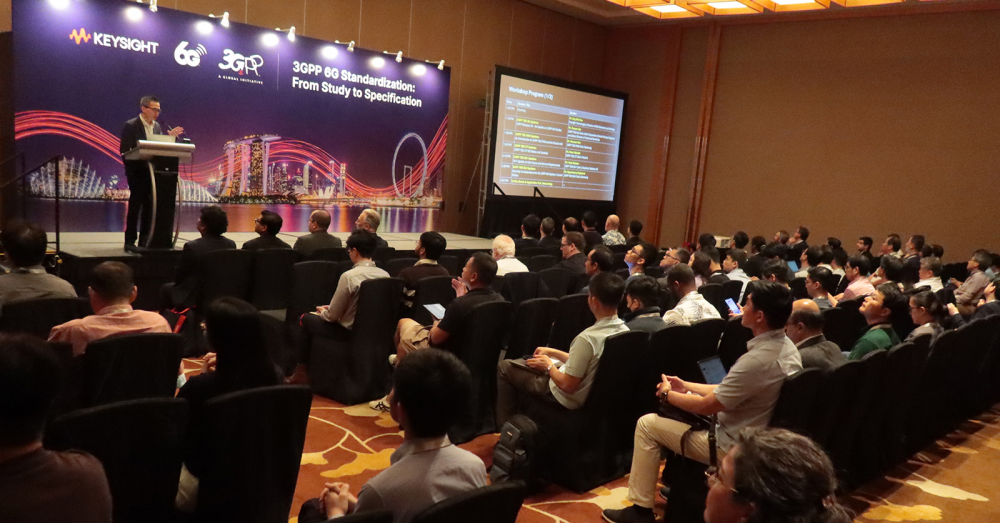
With over 300 contributions submitted, the meeting covered nearly every aspect of 6G standardization — from technical solutions and standard terminology to architectural design and tool selection. The plenary advanced work across all three Technical Specification Groups: Radio Access Network (RAN), Services & Systems Aspects (SA), and Core Network & Terminals (CT).
Release 21 Timeline Officially Set: Four Key Freeze Points
The most significant outcome of the meeting was the official approval of the full timeline for Release 21 (Rel-21) — the first 3GPP release to include normative 6G work. The 3GPP 6G timeline, first unveiled in March, has remained stable and was formally agreed upon at the Singapore plenary.
The Rel-21 development cycle is expected to run from March 2027 to March 2029, with four key freeze points:
3GPP TSG RAN Chairman Younsun Kim stated during the joint session that this timeline provides a firm commitment and clear direction for the next phase of work. The first commercial 6G systems are expected to launch around 2030.
23 6G Projects in Progress, CT Domain Adds 6 New Study Items
As of this meeting, 3GPP has a total of 23 6G projects (including 6 newly approved) — with 1 already completed, 1 concluded at this meeting, and 21 projects still in active development.
Notably, the CT (Core Network & Terminals) domain approved 6 new 6G study items in a single session, increasing its project count from 4 to 10. These new study items, led by CT1, CT3, and CT4 working groups respectively, focus on critical areas including 6G core network protocols, network capability exposure, terminal mechanisms, and specialized services — covering 6G core network data framework architecture, network capability exposure protocol design, AI application-specific protocol development, and more.
Additionally, after 18 months of research, the 6G Scenarios and Requirements study (FS_6G_RAN_Scen_Req) was officially concluded at this plenary, with Technical Report TR 38.914 finalized. The study identified typical usage scenarios for 6G radio technology and the required capabilities for each scenario, aligning with ITU-R's 6G Framework (M.2160).
China Telecom Leads "Integrated Sensing and Communication" Standardization Project
Of particular note, at the TSG RAN plenary session, the "Integrated Sensing and Communication" standardization project (New WID on Integrated Sensing And Communication for NR), led by China Telecom, was officially approved. The China Telecom Research Institute serves as the rapporteur for this project.
The project targets base station self-transmitting and self-receiving sensing mode for low-altitude unmanned aerial vehicle (UAV) scenarios, and will develop standards for network architecture, sensing procedures and signaling, as well as sensing data reporting formats — enabling signaling and data interoperability between base stations and core network sensing elements, and achieving end-to-end sensing service闭环. The project has gained significant attention at 3GPP, with support from 46 global companies (including 14 domestic and international operators).
This project not only provides unified international technical standards for 5G-Advanced low-altitude integrated sensing and communication, but also serves as a critical reference for 6G integrated sensing and communication standardization.
IARIS Perspective
The International Alliance for Regional Innovation and Standardization (IARIS) recognizes the 3GPP 112th Plenary Meeting as a milestone event in global communications standardization. The official approval of the Rel-21 timeline provides the global industry with clear R&D anchors and timelines — enabling chipmakers, equipment vendors, and operators to allocate R&D resources with precision.
Of particular note is the significant role played by Chinese enterprises in this 6G standardization process — the "Integrated Sensing and Communication" project led by China Telecom received support from 46 global companies and was officially approved. This reflects the growing influence and voice of the Asia-Pacific region in 6G and next-generation communications technology standards.
IARIS will continue to actively promote collaboration and experience sharing in 6G and future communications technology standards across the Asia-Pacific region, helping the regional communications industry play an even greater role in the global 6G standardization process, and contributing to the building of an open, collaborative, and inclusive global communications standards ecosystem.