Canada joins international effort to shape responsible AI standards

16 Jun, 2026

SCC signs arrangement with standards bodies from Singapore, the United Kingdom, Republic of Korea, and Australia to support practical work on AI governance, testing, and international standards.

SCC signs arrangement with standards bodies from Singapore, the United Kingdom, Republic of Korea, and Australia to support practical work on AI governance, testing, and international standards.

As artificial intelligence moves rapidly into workplaces, public services, and consumer products, countries are working to build the standards that will help make AI systems safe, trustworthy, and interoperable.

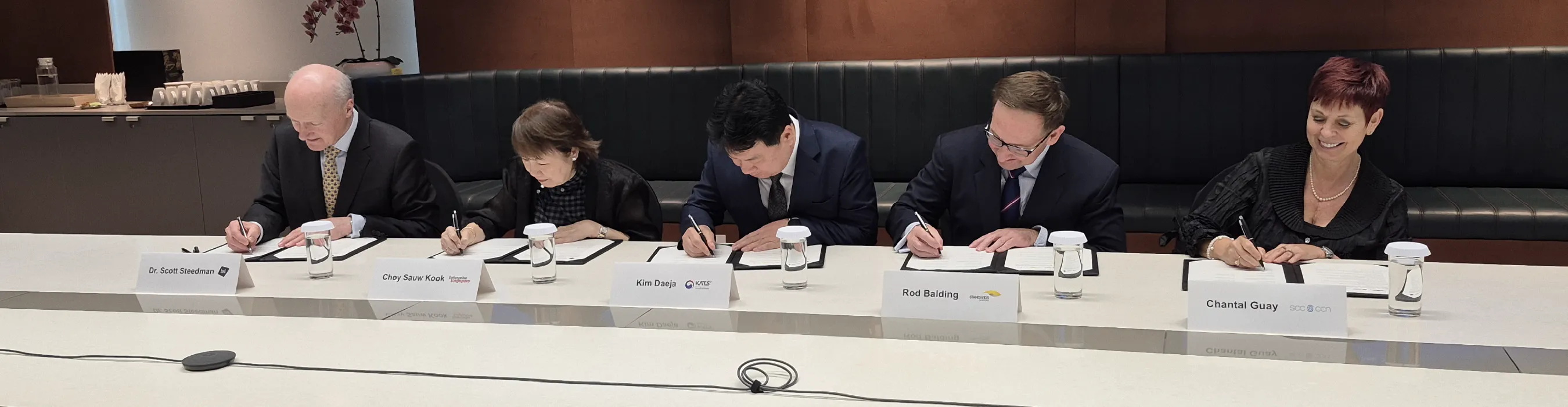
The Standards Council of Canada (SCC) has joined a new multilateral arrangement with the British Standards Institution (BSI), Enterprise Singapore (EnterpriseSG), the Korean Agency for Technology and Standards (KATS), and Standards Australia to advance practical work on AI governance, testing, and international standardization. The Memorandum of Understanding was signed on June 10, 2026, in Singapore, where international standards leaders had gathered for the Standards & Conformance Gala Dinner Summit.

“Canada will be fundamentally impacted by how AI standards take shape globally,” said SCC CEO Chantal Guay, who attended the signing. “This agreement gives us structured ways to work with trusted partners on the governance frameworks and technical tools that countries and industries will use to deploy and assess AI responsibly. That matters for Canadian businesses, for regulators, and for the people relying on these technologies.”

Pre-standardization is the work that happens before formal standards are written: testing ideas, comparing approaches, developing guidance, and gathering evidence from real-world use. For AI, this early work is especially important because the technology is evolving faster than traditional standards processes can often follow.

For Canadian companies, this collaboration can help reduce uncertainty as AI rules and expectations evolve across borders. For regulators, it can support more consistent approaches to assessing AI systems. For the public, it contributes to the safeguards that help determine whether AI can be used with confidence.

The agreement will see the participants co-develop frameworks and toolkits to bridge the gap between the rapid pace of AI development and formal standardization processes, including through knowledge exchange and capacity building, technical collaboration, pilots, and increased coordination in international standards forums.

SCC has been working with Canadian technical experts for years on standards for AI governance, risk management, and trustworthiness, supporting participation in ISO/IEC JTC 1/SC 42. The MOU formalizes collaboration with peer bodies in the UK, Singapore, Korea, and Australia and gives SCC and its partners a structured way to help ensure future standards are grounded in practical experience and real-world evidence. This fall, Canada will also host the international plenary for ISO/IEC JTC 1/SC 42.



Canada joins international effort to shape responsible AI standards

16 Jun, 2026

SCC signs arrangement with standards bodies from Singapore, the United Kingdom, Republic of Korea, and Australia to support practical work on AI governance, testing, and international standards.

SCC signs arrangement with standards bodies from Singapore, the United Kingdom, Republic of Korea, and Australia to support practical work on AI governance, testing, and international standards.

As artificial intelligence moves rapidly into workplaces, public services, and consumer products, countries are working to build the standards that will help make AI systems safe, trustworthy, and interoperable.

The Standards Council of Canada (SCC) has joined a new multilateral arrangement with the British Standards Institution (BSI), Enterprise Singapore (EnterpriseSG), the Korean Agency for Technology and Standards (KATS), and Standards Australia to advance practical work on AI governance, testing, and international standardization. The Memorandum of Understanding was signed on June 10, 2026, in Singapore, where international standards leaders had gathered for the Standards & Conformance Gala Dinner Summit.

“Canada will be fundamentally impacted by how AI standards take shape globally,” said SCC CEO Chantal Guay, who attended the signing. “This agreement gives us structured ways to work with trusted partners on the governance frameworks and technical tools that countries and industries will use to deploy and assess AI responsibly. That matters for Canadian businesses, for regulators, and for the people relying on these technologies.”

Pre-standardization is the work that happens before formal standards are written: testing ideas, comparing approaches, developing guidance, and gathering evidence from real-world use. For AI, this early work is especially important because the technology is evolving faster than traditional standards processes can often follow.

For Canadian companies, this collaboration can help reduce uncertainty as AI rules and expectations evolve across borders. For regulators, it can support more consistent approaches to assessing AI systems. For the public, it contributes to the safeguards that help determine whether AI can be used with confidence.

The agreement will see the participants co-develop frameworks and toolkits to bridge the gap between the rapid pace of AI development and formal standardization processes, including through knowledge exchange and capacity building, technical collaboration, pilots, and increased coordination in international standards forums.

SCC has been working with Canadian technical experts for years on standards for AI governance, risk management, and trustworthiness, supporting participation in ISO/IEC JTC 1/SC 42. The MOU formalizes collaboration with peer bodies in the UK, Singapore, Korea, and Australia and gives SCC and its partners a structured way to help ensure future standards are grounded in practical experience and real-world evidence. This fall, Canada will also host the international plenary for ISO/IEC JTC 1/SC 42.