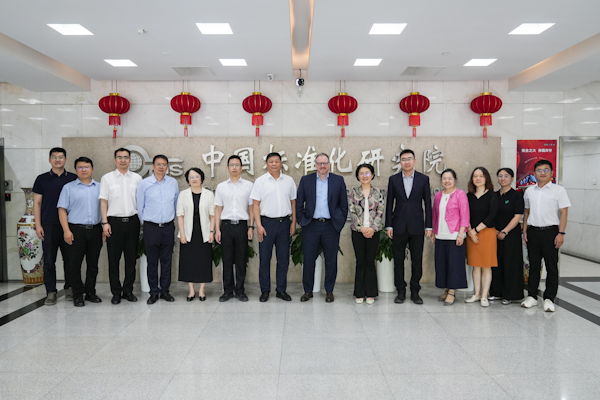
BEIJING — From June 8 to 9, 2026, Francis Pennell, Head of the SMART Standards Single Delivery Unit (SDU) of the International Electrotechnical Commission (IEC) and the International Organization for Standardization (ISO), visited the China National Institute of Standardization (CNIS). The two sides held in-depth discussions over two days on topics related to standard digitalization.
Standard Digitalization: A Paradigm Shift from Paper to Intelligent Interoperability
SMART stands for "Standards Machine Applicable, Readable and Transferable". In 2019, ISO and IEC formally introduced the concept of SMART standards, defining five stages of standard digitalization capability: paper text, open data format, machine-readable document, machine-readable content, and machine-interoperable content. The core feature is that standards can be machine-readable, usable, understandable, and resolvable without human intervention.
SMART standards represent a fundamental transformation of international standards — from document-centric content to machine-executable data. In the future, international standards will no longer be merely paper or PDF documents, but digital products delivered in the form of software.
In-Depth Exchanges: Focus on Core Issues of Standard Digitalization
At the standard digitalization exchange meeting held on the morning of June 8, CNIS presented an overview of the institute and China's standard digitalization developments. Mr. Pennell introduced the latest progress in SMART governance mechanisms and digital tool development pilots. The two sides exchanged views on further strengthening cooperation.
Relevant officials from the Department of Standardization Innovation of the State Administration for Market Regulation attended the meeting and delivered remarks. The meeting was chaired by Chen Weiliang, Vice President of CNIS. Participants included representatives from the Department of Standardization Innovation, the Department of Standardization Technology, the Chinese Academy of Quality and Inspection and Testing, the National Standardization Technical Review Center, and CEPREI Certification Body.
From the afternoon of June 8 to June 9, the CNIS National Standards Library (Standard Digitalization Research Center) held two thematic seminars with Mr. Pennell on the creation, management, and use of digital standard content. The two sides conducted thorough and in-depth exchanges on the following core topics:
ISO/IEC Online Standards Development Platform (OSD) — transitioning international standards development from offline meetings to cloud-based collaboration;
National Standards Intelligent Development System (SIDS) — China's independent innovation in standard digitalization;
Digital standard information modeling — digital modeling and structured representation of standard content;
SMART content delivery and application integration — practical application scenarios for intelligent standards;
Standard AI tool development — AI-empowered standards development and utilization.
Strong Alignment: Strategic Directions Resonate Deeply
Mr. Pennell noted that the two sides are highly aligned in strategic direction, R&D philosophy, technical approaches, and the key pain points they face. He commended CNIS's research and progress in standard digitalization and expressed hope for further deepening cooperation between the technical teams on relevant topics in the future.
CNIS stated that it will continue to strengthen communication and technical exchanges with the SDU, actively participate in ISO and IEC standard digitalization efforts, and leverage international best practices to provide technical support for advancing China's standard digitalization transformation.
IARIS Perspective
The International Alliance for Regional Innovation and Standardization (IARIS) recognizes the visit of the IEC and ISO SMART Standard Digitalization Lead to China as a reflection of the high value international standards organizations place on China's exploration and practice in the field of standard digitalization.
Standard digitalization represents one of the most transformative trends in international standardization today. The transition from traditional paper text to machine-readable, executable, and interoperable intelligent standards will fundamentally reshape the development methods, delivery formats, and application scenarios of standards. In this process, international cooperation is essential — no single country or organization can accomplish this systemic transformation alone.
Notably, China has established a relatively systematic framework in standard digitalization — from the National Standardization Development Outline's call for building a National Digital Standards Library, to the development of the "Standard Digitalization" series of national standards, to the development of the National Standards Intelligent Development System (SIDS). China is steadily advancing on the path of standard digitalization transformation.
IARIS will continue to monitor international developments in standard digitalization and promote exchanges and cooperation across the Asia-Pacific region on standard digitalization technical approaches, governance mechanisms, and application practices, jointly embracing the standardization transformation of the digital era.